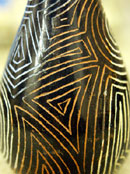
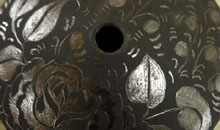
|
PROGRAMS
|
|
SCHEDULE
|
During
these courses the different working cycles are experimented and the
students will have a large assortment of supplies, equipment and firing
kilns at their disposal. There is also video documentation and a bibliography
on the history of ceramic art. For this reason the courses can be followed
both by beginners and advanced students.
INTRODUCTORY
COURSE IN HANDBUILDING, USE OF GLAZES AND FIRING TECHNIQUES
The course covers all the basic techniques for hand building shapes
in clayworking, firing and decorating ceramics, and lays the necessary
foundations for exploring its many possibilities. The course is carried
out through practical experience into the initial stages - properties
and preparation of the clay, hand-building techniques (modelling, slab,
coil etc.), characteristics and application of colour (engobes, oxides,
glazes) and an introduction to firing techniques. At the end of the
course students will be given useful information for setting up their
own workshop and all ceramics produced during the course can be taken
home.
The
brief coure from 2 to 6 january will deal with the techniques of firing
with gas and electric kilns: preparation of glazes and colours for raku
firing, maiolica glazes and special effects with gas and electric firings.
The pieces already fired will be fournished by the school.
|
Tutors:
,Andrea
Sola,
(C.
V. and images)
images
of the course
IMAGES
OF THE WORKSHOPS
21 - 29 August
EURO 500
If
interested in doing the courses in different periods, please let us know:
we will take notice and inform you on availabiity
|
|
COLOR IN
CERAMICS:
all kinds of decoration techniques in high and low temperatures
The course deals with the techniques of colouring all kinds of ceramic
surfaces, developing the matter under the design and technical point of
view.
The various possibilities that ceramic materials offer will be studied
in relationship to the chromatic and tactile quality of surfaces and their
harmony with the shapes.
The following techniques will be held:
- Hand building and application of textures, etching, relieves, study
of different graphic- solutions.
- Engobes: row applications, glazed engobes on fired surfaces, etching
and area filling.
- Ceramic coatings with calcareous clays for high temperature: study of
colouring and techniques of superimposition..
- Painting with colours and glazes: brush, airbrush, hand pump; brushing
technique.
- Ceramic pastels: making and use.
All the range of temperatures will be used: from 1100° to 700°.
This courses can be followed both by beginners and advanced students.
|
Tutor:
Mirco
Denicolò
personal
site www.mircodenicolo.it
images
of the course
ceramic
decoupage
images
of the workshops
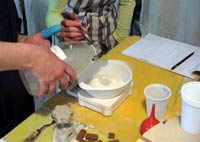
SAME
SCHEDULE OF THE HANDBUILDING COURSE
If
interested in doing the courses in different periods, please let us know:
we will take notice and inform you on availabiity
|
RAKU
AND WOOD REDUCTION TECHNIQUES:
pit fire, saw dust, bucchero,
naked raku
This course aims at approaching the various expressive shapes of today's
ceramics through the use of ancient techniques renewed and enriched
with new experimentations.
All the firing techniques held in this course belong to the family of
the oxygen reduction firings through wooden materials: the chromatic
effects produced on the surface of the objects have the peculiarity
to be partially unforeseeable: this means that they assume the aspect
of a primitive fashion that strongly influence the nature of the shapes.
These techniques can be divided in two groups:
- reductions on the glaze (Raku and naked Raku), done with a gas firing:
raku is based on quick firing of glazed objects then reduced during
the cooling process.
- the reduction techniques applied on terracotta, without using glazes:
Bucchero (the ancient technique of Etruscan origin), exploring all the
different possibilities of making reduction and burnishing the surface,
pit fire, saw dust fire. These techniques require that surfaces are
always prepared with "terre sigillate" and burnishing process.
The clays will be strongly refractory. All the pieces will be built
during the course with the different techniques of cooling, slab and
wheel.
During the course will be prepared all kind of glazes for Raku firing;
naked technique will also be learned.
Different degrees of smoking will be tested: saw dust and wood. All
row materials will be analysed and tested in their various uses. Will
be followed the complete process of preparation of terre sigillate.
Will also be learned how to built and conduct a gas kiln.
Particular care will be own to shapes and surfaces, that will be preferably
simple and near to the regular solid shapes, to emphasize this kind
of effects.
A large room will be given, in the projecting works, to the research
of individual creative capacities.
|
Tutors:
Andrea Sola
,
images
of the workshops
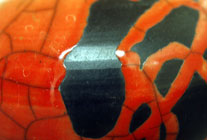
SAME
SCHEDULE OF THE HANDBUILDING COURSE
If
interested in doing the courses in different periods, please let us
know: we will take notice and inform you on availabiity
|
|
THE
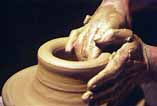
TECHNIQUE OF THROWING ON THE WHEEL
Through
a series of guided practical exercises, the initial stages of throwing
are taught by a well-tested method in which students acquire the correct
position for the technique. Students are given the opportunity to throw
on an electric wheel and to learn the basic steps which will allow them
to continue alone. During the course students will also learn how to finish
off pieces by the use of additionto hand-building or moulds.

|
Tutors:
Andrea Sola,
images
of the workshops
SAME
SCHEDULE OF THE HANDBUILDING COURSE
If
interested in doing the courses in different periods, please let us know:
we will take notice and inform you on availabiity
|
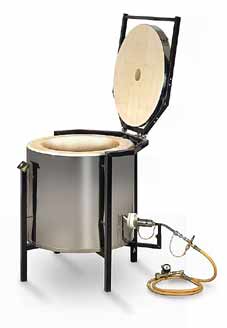
MOBILE
GAS KILN
The kiln,
very cheap for the price and consumption, is able to execute all kinds
of firing (first firing, glazes, gas and wood reductions, metallic reflections,
raku, stoneware).
Temperature
1200 °
During raku firring the kiln reach 950° in 45 min. and then it will
reach again the same temperature in 15/20 min.
The kiln can also
icrease the temperature very slowly if needed.
TECHNICAL
DATA AND INFORMATION
|
|
|
|
|
|